
Post 2 / 4
- Behavioral Science in Dog Training: How Do Dogs Actually Learn?
- Classical Conditioning: How Do Dogs Learn Associations?
- Operant Conditioning: Why Do Some Behaviors Repeat While Others Disappear?
- Instinct and Evolution: How Biology Influences Dog Behavior?
Classical Conditioning: How Do Dogs Learn Associations?
When people talk about dog training, they often think about teaching commands: sit, down, come. But a large part of a dog’s behavior does not begin with a command or a conscious decision. It begins with what a situation means to the dog.
This idea was scientifically formulated by the Russian physiologist Ivan Pavlov , who originally studied digestion in dogs. During his laboratory experiments Pavlov noticed something surprising: the dogs began to salivate even before the food arrived. The footsteps of the lab assistant, the sound of the food bowl, or other environmental cues that had previously been associated with food were enough.
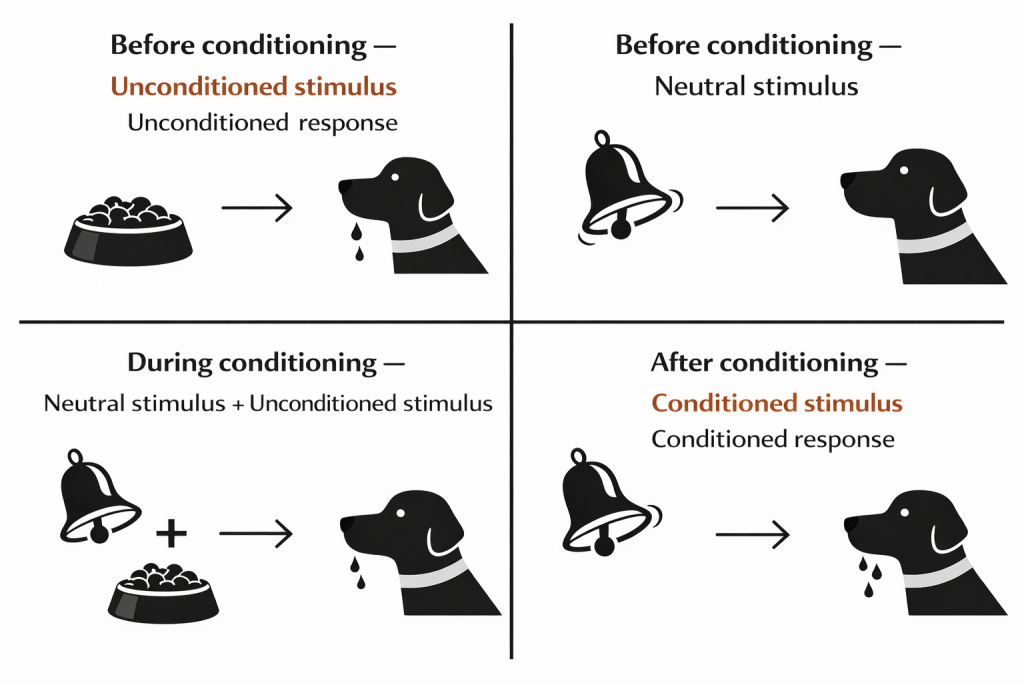
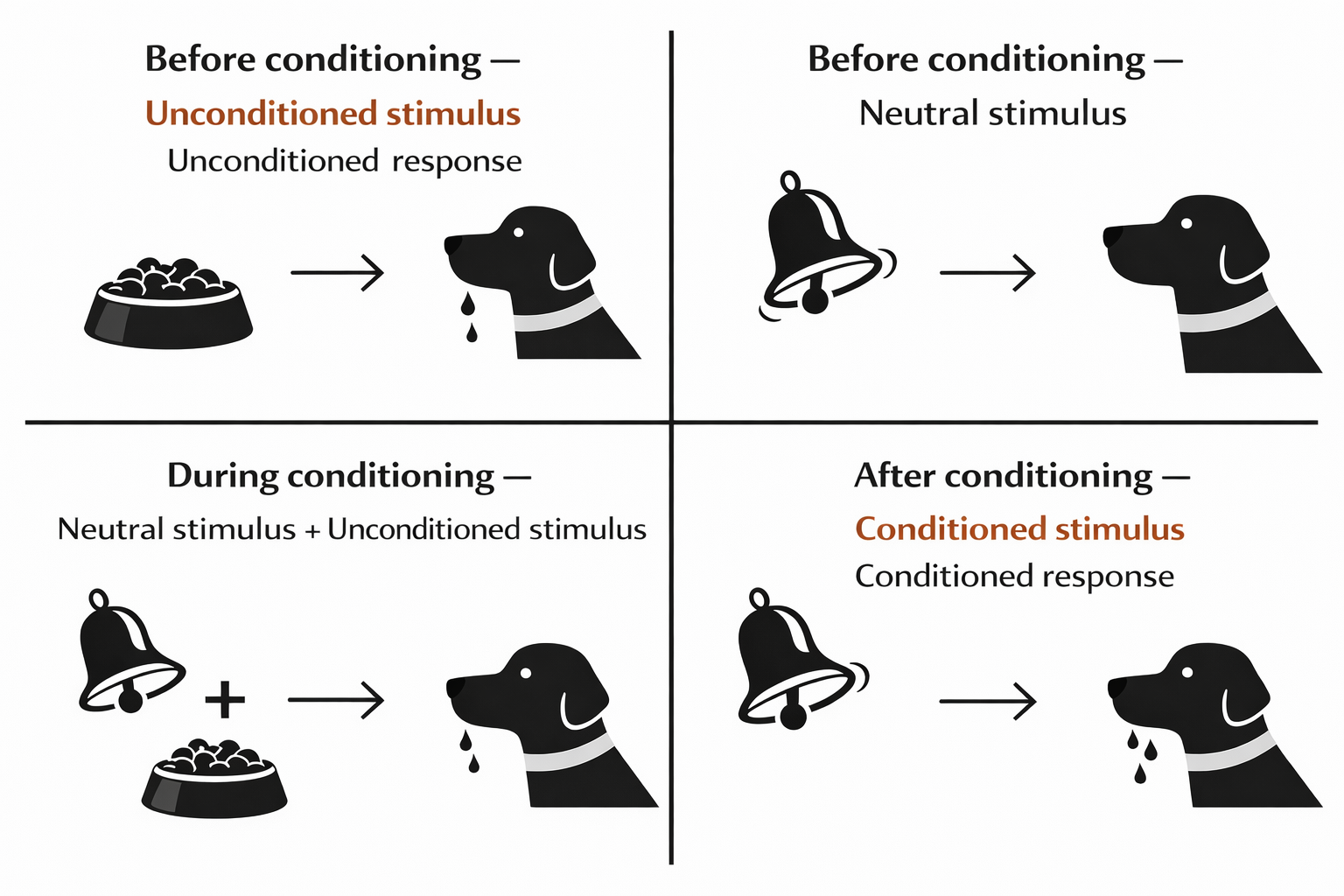
This observation led to Pavlov’s famous experiments. If a neutral stimulus — for example a bell or metronome — was repeatedly presented right before food, the dog eventually began to salivate in response to the sound alone. Food caused the natural reaction, but the sound gained meaning through learning (Pavlov, 1927) .
What Is Classical Conditioning?
Classical conditioning essentially means learning what predicts what. An organism learns that one event signals another event.
A previously neutral stimulus gradually becomes meaningful because it has been repeatedly paired with a biologically significant event. This process does not require conscious decision-making. The association forms automatically at the level of the nervous system (Bouton, 2007).
Later researchers emphasized that classical conditioning is not simply the formation of a reflex, but primarily learning about which events predict other events (Rescorla, 1988).
What Does This Mean in Dog Training?
For a dog, the environment is not just a neutral background. Every place, sound, or situation can gradually acquire meaning.
For example:
- a leash may predict a walk
- seeing another dog may predict conflict
- the scent of wildlife may predict a hunting opportunity
These associations often form before the dog even has time to choose a behavior. That is why reactions can be very fast and emotional.
Neuroscience research has shown that brain structures related to emotions can activate before more conscious decision-making processes (LeDoux, 2014).
Why Is This Important in Training?
When a dog is in a strong emotional reaction — for example fear or extreme excitement — the problem is often not that the dog does not know the command. The problem is that the situation itself has acquired a strong meaning.
That is why many behavior problems cannot be solved only by teaching obedience. Often it is necessary to change what the situation means to the dog: to create new associations or weaken old ones.
In other words: before we can change behavior, we must understand which emotional associations are triggering it.
References
Pavlov, I. P. (1927). Conditioned Reflexes. Oxford University Press.
Rescorla, R. A. (1988). Pavlovian conditioning: It’s not what you think it is. American Psychologist, 43(3), 151–160.
Bouton, M. E. (2007). Learning and Behavior: A Contemporary Synthesis. Sinauer Associates.
LeDoux, J. (2014). The Emotional Brain. Copernicus Center Press.