
Post 1 / 4
- Behavioral Science in Dog Training: How Do Dogs Actually Learn?
- Classical Conditioning: How Do Dogs Learn Associations?
- Operant Conditioning: Why Do Some Behaviors Repeat While Others Disappear?
- Instinct and Evolution: How Biology Influences Dog Behavior?
Behavioral Science in Dog Training: How Do Dogs Actually Learn?
When discussing dog training, we often focus on technical questions: What should you do if your dog pulls on the leash? How can you reduce reactivity when passing other dogs? Which training method works best? Behavioral science approaches these questions more deeply. Before we try to change behavioral patterns, we must understand how a dog actually learns – what happens in the dog’s nervous system and why some reactions appear before the dog is able to make a better “choice”.
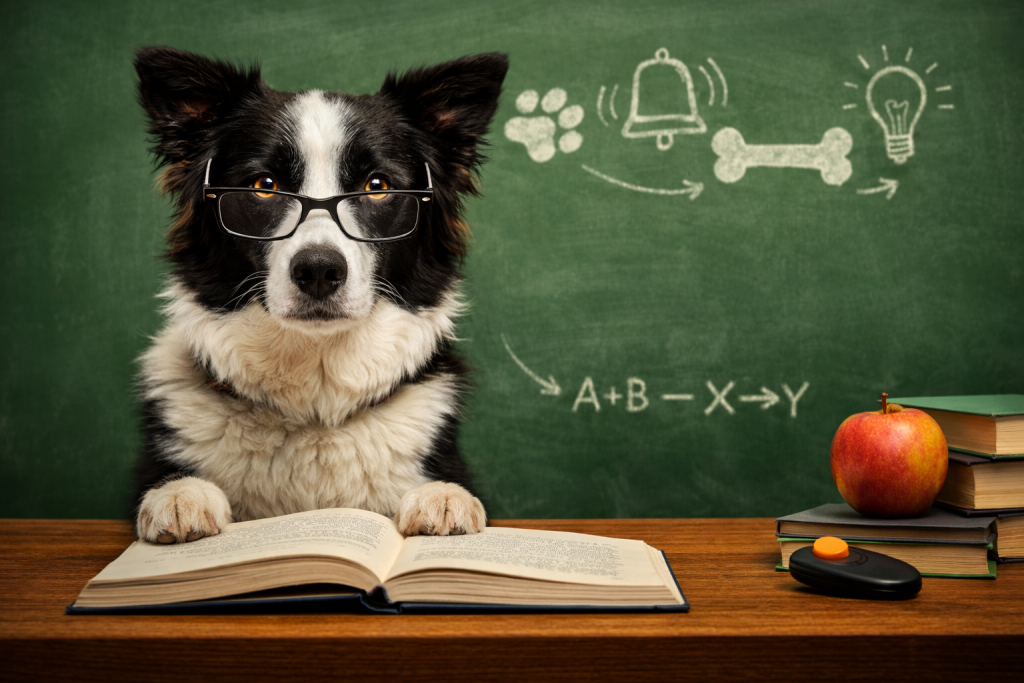
In this four-part series “Behavioral Science in Dog Training” we will examine four major scientific perspectives that help explain how dogs learn and why their behavior develops the way it does: classical conditioning (Pavlov), operant conditioning (Skinner), ethology (instinct and species-specific behavior), and evolutionary psychology (why avoidance and threat signals can be such powerful drivers of learning).
An important idea connecting these perspectives is simple: a dog’s behavior is not primarily a matter of “personality”, but is to some degree always functional. Behavior helps the dog achieve something (for example increasing distance, gaining access to something interesting, or creating a sense of safety) or avoid something. If we fail to recognize this function, we tend to deal only with symptoms.
Another important aspect is the role of emotions in learning. A dog may perform the command “sit” perfectly at home but fail in an environment where it feels stressed or anxious. This does not mean the dog “doesn’t know” the command – it means that the state of the nervous system directly influences the ability to respond. Emotions and learned associations can strongly affect which behaviors are even available to the dog in that moment. (Bouton, 2007) .
For this reason, it is helpful to separate two questions:
- What does the dog feel and what does the situation mean to the dog? (classical conditioning)
- What causes a behavior to repeat or disappear? (operant conditioning)
Alongside these, there are two additional questions:
- What part of behavior is instinct and species-specific behavior? (Tinbergen, 1963)
- Why is avoiding danger in certain situations often a faster and more effective learning strategy than trying to associate everything only with pleasant experiences? (Tooby & Cosmides, 1992)
The logic of this series is the following. In the next article we will look at Ivan Pavlov’s work and explore why learning begins with meaning and emotions. In the third part we will examine B. F. Skinner’s work and why certain behaviors persist. In the fourth part we will connect instinct and evolution – why the dog is not a “blank slate” that can simply be rewritten with treats.
A short practical thought to finish. If you have a dog that reacts strongly when seeing another dog, teaching the command “sit” can be a very useful skill. But if the dog is already in a heightened emotional state, we must first ask: what does the other dog mean to your dog, what reaction does it trigger, and how can we guide the dog toward the desired response?
References
Bouton, M. E. (2007). Learning and Behavior: A Contemporary Synthesis. Sinauer Associates.
Tinbergen, N. (1963). On aims and methods of ethology. Zeitschrift für Tierpsychologie, 20, 410–433.
Tooby, J., & Cosmides, L. (1992). The psychological foundations of culture. In The Adapted Mind. Oxford University Press.