
Behavioral Science in Dog Training
Post 4 / 4
- Behavioral Science in Dog Training: How Do Dogs Actually Learn?
- Classical Conditioning: How Do Dogs Learn Associations?
- Operant Conditioning: Why Do Some Behaviors Repeat While Others Disappear?
- Instinct and Evolution: How Biology Influences Dog Behavior
Instinct and Evolution: How Biology Influences Dog Behavior
Pavlov and Skinner explain how learning works. Ethology and an evolutionary perspective explain why dogs naturally do certain things so easily. Some behaviors are biologically “prepared” — they require less learning because they have historically been beneficial for the species.
Ethology: Behavior Is Not Random
Ethology studies the natural behavior of animals and its function. Tinbergen proposed a classical framework: behavior cannot be understood from a single angle. Instead we must ask four questions — what triggers it, how it develops, what function it serves, and how it evolved.
(Tinbergen, 1963)
For dogs this means, for example, that hunting, chasing, grabbing, herding, territorial control, social distance, and body language are not simply “training mistakes”. They are partly biological patterns. Training must therefore give these behaviors a framework: where, when, and how much.
Why Are Avoidance and “Threat Signals” So Powerful?
Evolutionary psychology emphasizes that the nervous system evolved for survival. Organisms often learn about danger and unpleasant experiences faster than neutral ones, because historically the cost of making a mistake was high. This is why unpleasant experiences or threat signals can create strong and rapidly formed associations.
(Tooby & Cosmides, 1992)
In training this leads to two very practical conclusions:
- If the dog is in an excited or highly aroused state, teaching does not work as effectively — the state and environment must first be changed.
- If pressure is applied expecting a certain behavior or when correcting unwanted behavior through discomfort, timing must be precise and the level proportional. Otherwise there is a risk of generalization (the dog associates the wrong thing) and inefficiency (the correction is not meaningful enough and the dog repeats the behavior).
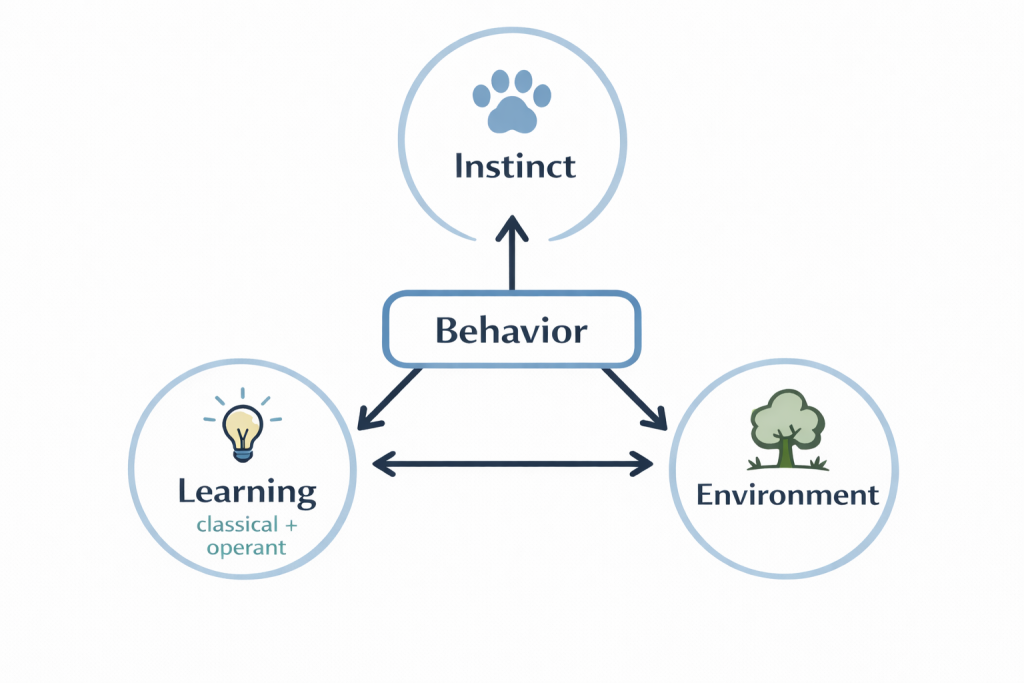
Instinct + Learning: The Same System, Different Layers
Instinct gives behavior its direction (what the dog wants to do), while learning determines when and how reliably that direction appears in real life. For example, prey drive may be strong, but an operant framework can teach: “Yes, you see a wild animal, but you maintain engagement with me and move forward.”
This is why a “balanced” approach is essentially systematic: we do not fight biology, we work with it inside a structured and safe framework.
References
- Tinbergen, N. (1963). On aims and methods of ethology. Zeitschrift für Tierpsychologie, 20, 410–433. https://doi.org/10.1111/j.1439-0310.1963.tb01161.x
- Tooby, J., & Cosmides, L. (1992). The psychological foundations of culture. In J. H. Barkow, L. Cosmides, & J. Tooby (Eds.), The Adapted Mind (pp. 19–136). Oxford University Press.