
Behavioral Science in Dog Training
Post 3 / 4
- Behavioral Science in Dog Training: How Do Dogs Actually Learn?
- Classical Conditioning: How Do Dogs Learn Associations?
- Operant Conditioning: Why Do Some Behaviors Repeat While Others Disappear?
- Instinct and Evolution: How Biology Influences Dog Behavior?
Operant Conditioning: Why Do Some Behaviors Repeat While Others Disappear?
If Pavlov explained why a situation begins to mean something, B. F. Skinner examined the other side: why one behavior increases while another decreases. The core of operant conditioning is simple: the outcome (consequence) of a behavior influences how likely it is to occur again.
What Did Skinner Actually Show?
Skinner’s experiments demonstrated that behavior is not simply “personality”; it is often a function: the dog does what works for them. If pulling eventually leads to reaching an interesting smell, pulling continues. If barking brings attention from the owner, barking continues. If growling causes another dog to move away, growling continues. This does not mean the behavior is “good” or “bad” — it means the behavior has been effective.
(Skinner, 1953)
The Four Quadrants That Clarify the Picture
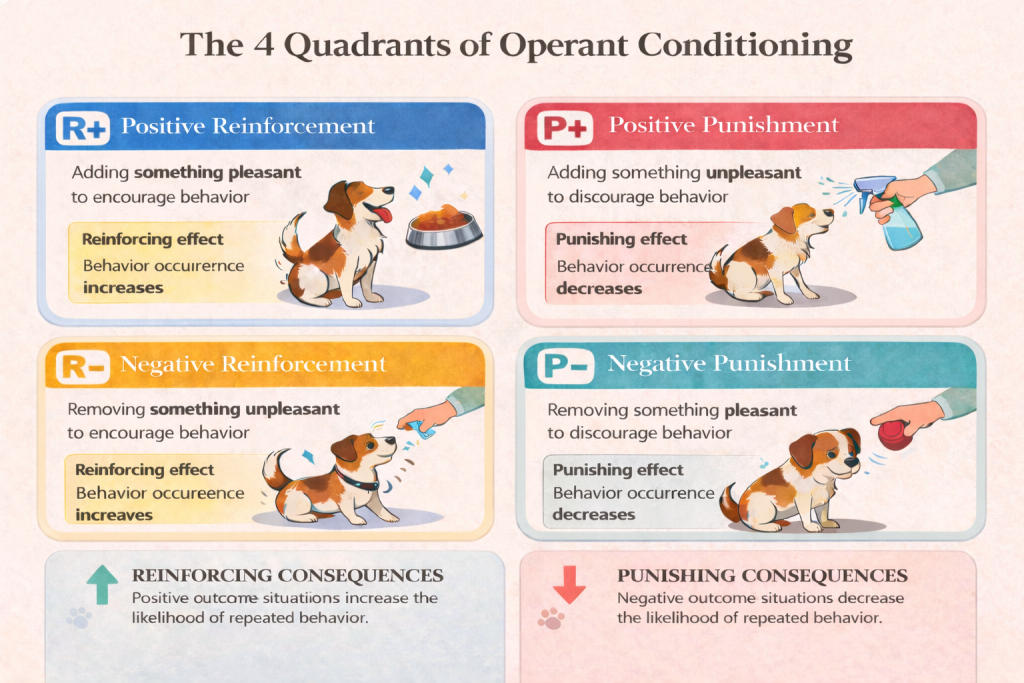
Operant learning is divided into four “quadrants”. They describe whether we add or remove something, and whether the behavior increases or decreases.
- Positive reinforcement (R+): we add something pleasant → the behavior increases (e.g., food, play, access).
- Negative reinforcement (R−): we remove something unpleasant → the behavior increases (e.g., pressure disappears, discomfort ends).
- Positive punishment (P+): we add something unpleasant → the behavior decreases (e.g., an intervention that reduces risk).
- Negative punishment (P−): we remove something pleasant → the behavior decreases (e.g., access/attention/play stops).
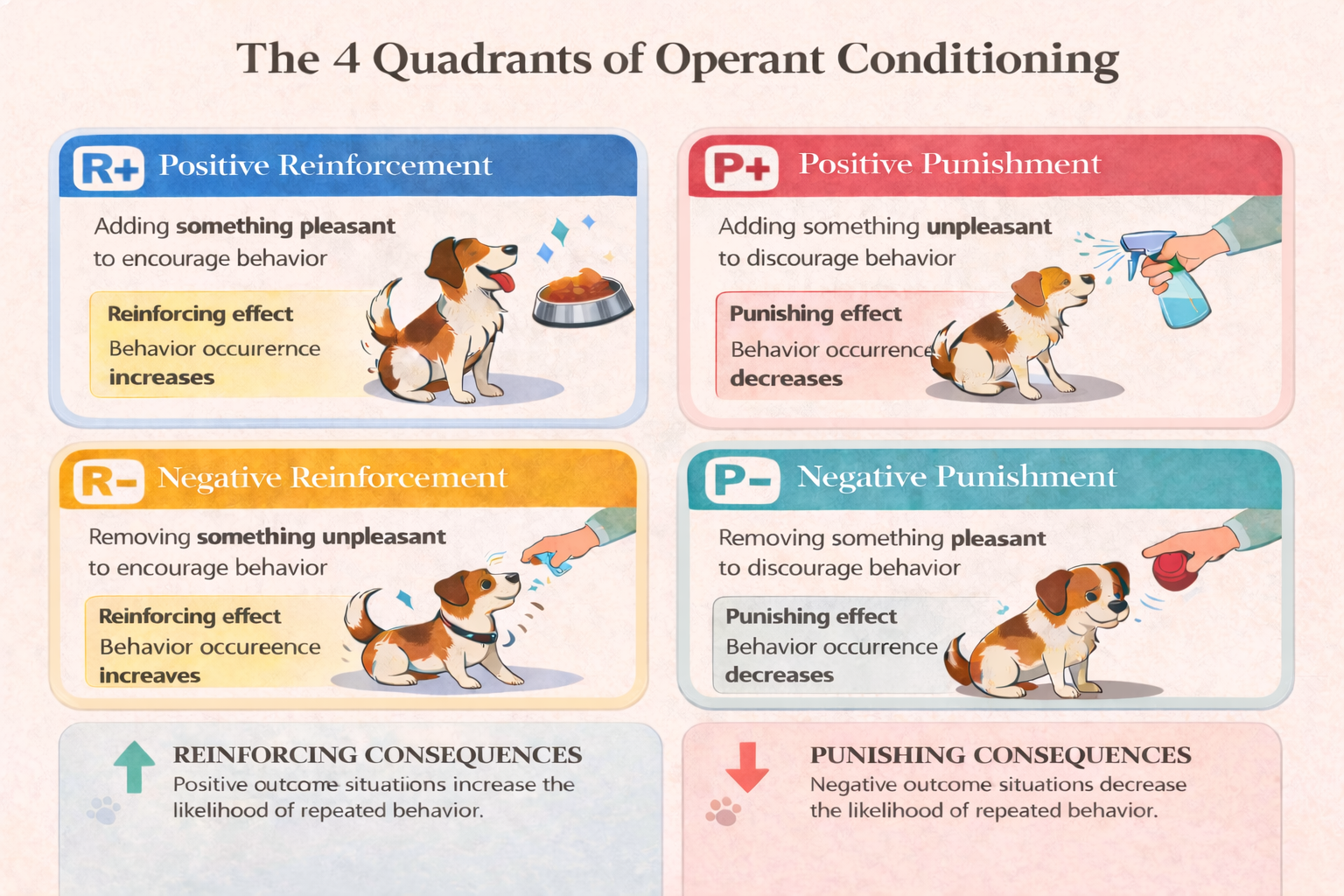
An important nuance: these terms are not emotionally loaded and do not mean “good” or “bad”. They simply describe what was done with the consequence and what happened to the frequency of the behavior.
(Skinner, 1938)
Why Does “Problem Behavior” Persist Even with Good Intentions?
Often the issue is not that the dog “doesn’t know”, but that the behavior is rewarded within the system. For example, reactivity may create distance (the other dog moves away), pulling may provide access (the dog reaches its goal), and jumping may gain attention (even negative attention is still attention). If we introduce a new training technique but leave the old “reward structure” intact, the old behavior will not disappear.
A Practical Framework: 3 Questions Before You Start Training
- What is the goal of the behavior for the dog? (what does the dog gain or avoid?)
- What consequence keeps the behavior alive? (does the dog gain access, distance, attention, smell?)
- What would be a “cheaper” alternative for the same goal? (what could the dog do instead that works better for you?)
Then you build the plan like this: make the old behavior ineffective (it no longer “works”) and make the new behavior logical for the dog (it works better). That is how operant learning works in real life.
References
- Skinner, B. F. (1938). The Behavior of Organisms: An Experimental Analysis. Appleton-Century-Crofts.
- Skinner, B. F. (1953). Science and Human Behavior. Macmillan.